
Harvard professors join urgent international effort to safeguard natural history and scientific infrastructure in Mongolia
Christina Warinner, Professor of Anthropology and Human Evolutionary Biology, and Scott Edwards, Professor of Organismic and Evolutionary Biology, have joined colleagues from 21 institutions to call for greater international support of natural history and scientific infrastructure in Mongolia. Mongolia has among the most important paleontological collections in the world, supports an incredible diversity of plant and animal wildlife, and is home to more than 1 million nomadic herders whose unique heirloom dairy microbes hold great unexplored probiotic potential for improving human health. Current geopolitical initiatives, rapidly changing climate, and emerging infectious diseases are threatening the long-term management and stewardship of these globally important resources. In an article published this week in the Proceedings of the National Academy of Sciences, the team outlines the significant challenges and potential solutions that are urgently needed to safeguard Mongolia’s rich biodiversity and cultural resources for the future.
Boldgiv B, Lkhagva A, Edwards S, Stenseth NC, Bayarsaikhan J, Altangerel D, Usukhjargal D, Dovchin B, Gombobaatar S, Batsaikhan N, Warinner C, Hart I, Galbreath K, Greiman SE, Malaney J, Murdoch JD, McLean B, DeWitte S, Manzitto-Tripp E, Chin K, Kaarim TS, Simpson C, Stevens NJ, Dunnum JL, Cook JA, and Taylor WTT. (2025) Global natural history infrastructure requires international solidarity, support, and investment in local capacity: lessons from Mongolia. Proceedings of the National Academy of Sciences 122 (6) e2411232122, https://www.pnas.org/doi/epub/10.1073/pnas.2411232122

The Southern Gobi of Mongolia supports a diversity of arid-adapted wildlife and herding families who maintain one of the world’s most unique dairy systems. Photo by Christina Warinner
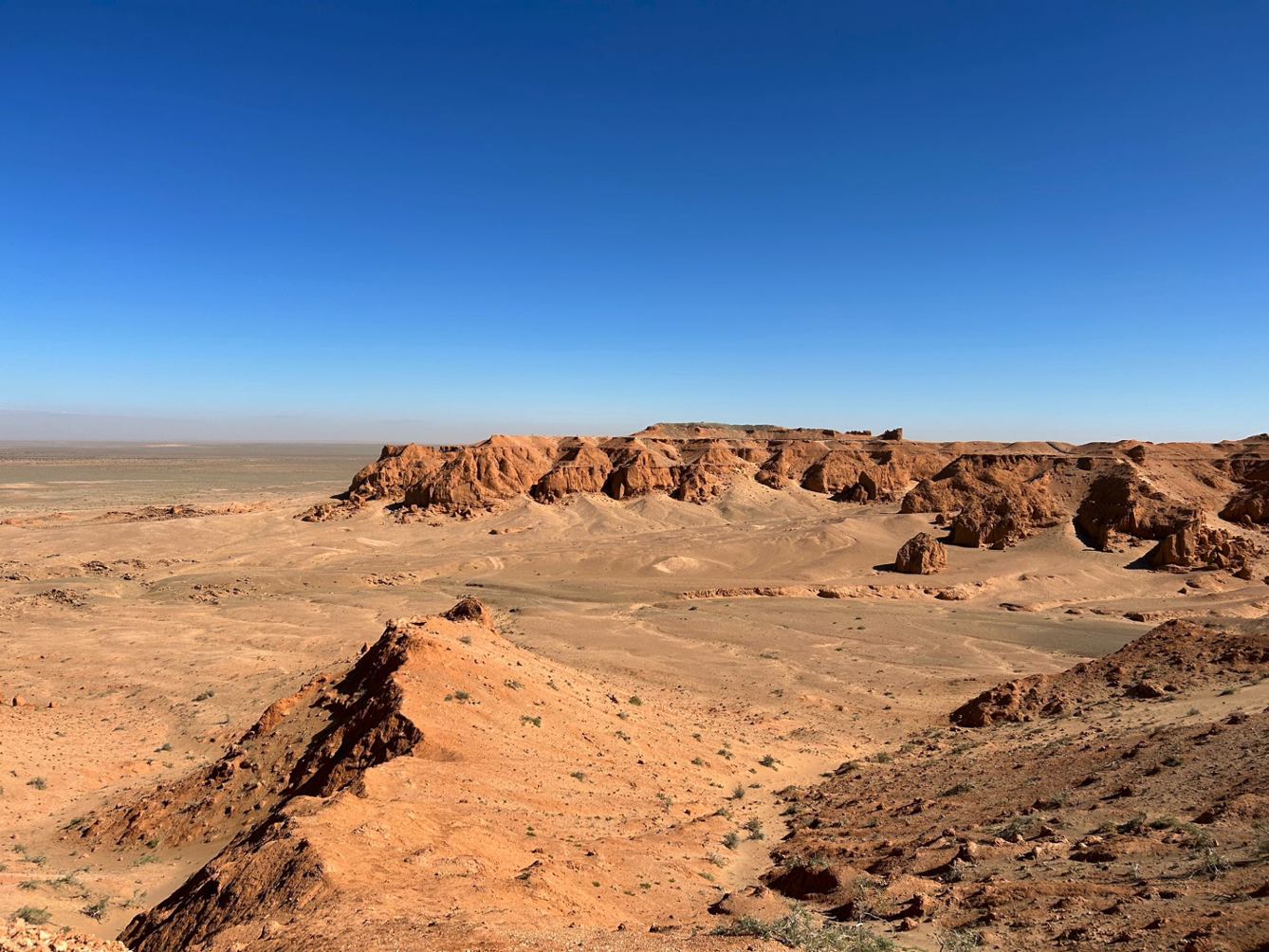
The Flaming Cliffs of Mongolia’s Gobi desert have yielded some of the most important paleontological fossils in the world, including the first discovered dinosaur eggs and the remains of Velociraptors and Oviraptors. The region is also believed to be the cradle of mammalian evolution during the Upper Cretaceous. Photo by Christina Warinner